
La Mesa City Directory Shelf
La Mesa’s historical shelf is wider than a single annual book. The La Mesa History Center archive reports La Mesa directories from 1887 through 1973 as an aggregate span, with city, county, and suburban volumes mixed together. That range is useful, but it is not a promise of an unbroken year-by-year run. The center’s research room is behind McKinney House in the Palermo Building; volumes are non-lending, and copies or photo prints carry a fee. The San Diego Public Library adds a much longer run, but a San Diego title can include county towns. Check the town listing and address before treating an entry as a La Mesa record.
| Collection | Years | Where Held | Access |
|---|---|---|---|
| La Mesa and San Diego-area directories, mixed publishers | 1887-1973 aggregate | La Mesa History Center | Onsite Saturdays; non-lending |
| San Diego directory volumes | 1886-2021 | San Diego Public Library California Collection | Special Collections onsite; verify La Mesa |
| Digitized San Diego directories | 1887-1925 | San Diego Yesterday | Online through the library collection |
| San Diego City Archives PDFs | 1925-1960 | City Archives digital files | Online PDF segments |
| La Mesa volume, San Diego Directory Co. | 1943 | Library and city-hosted PDF | Free online scan |
| San Diego volume, R. L. Polk & Co. | 1958 | Library and city-hosted PDF | Free online scan |
The rows overlap by design. A local La Mesa volume may be the best source for a street or family, while a San Diego directory can supply a nearby year when the local shelf has a gap. The History Center does not publish a volume-level missing-year list, so “1887-1973” should be read as collection coverage, not a claim that every year survives. The library’s 1886-2021 statement also covers the larger San Diego area. Search the page image, index, or town heading before copying a name into a family record.
Where La Mesa’s Historical Directory Volumes Sit
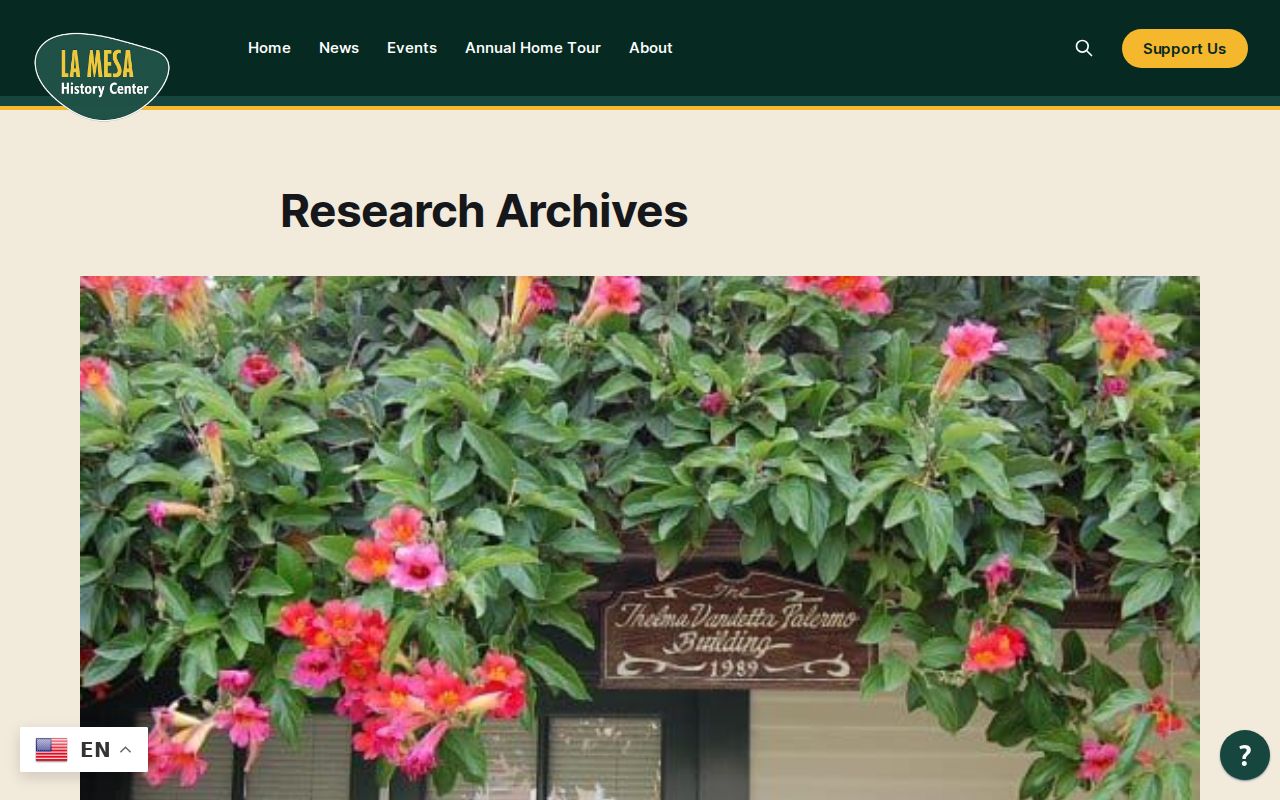
The La Mesa History Center is the most local starting point. Its holdings include directories, La Mesa Scout microfilm, Grossmont and Helix High School yearbooks, late-nineteenth-century-to-present photographs, address and subject vertical files, landmark nominations, oral histories, Woman’s Club records, Community Welfare Association ledgers, and family collections. The mix lets a researcher test a directory line against a photograph, school annual, clipping, or house file instead of treating one printed listing as the whole story.
The History Center research room is normally open Saturdays from 1 to 4, except holidays. Materials are for onsite use and copying or photo prints have a fee.
The center’s Preservica digital archive also identifies San Diego city and county directories. Online pages can supply a first name or address, while the local vertical file may explain a move, a house name, or a community connection. Regional manuscript collections also preserve La Mesa Springs and early booster material for researchers who need context beyond a directory line.
Digitized San Diego Directories for La Mesa
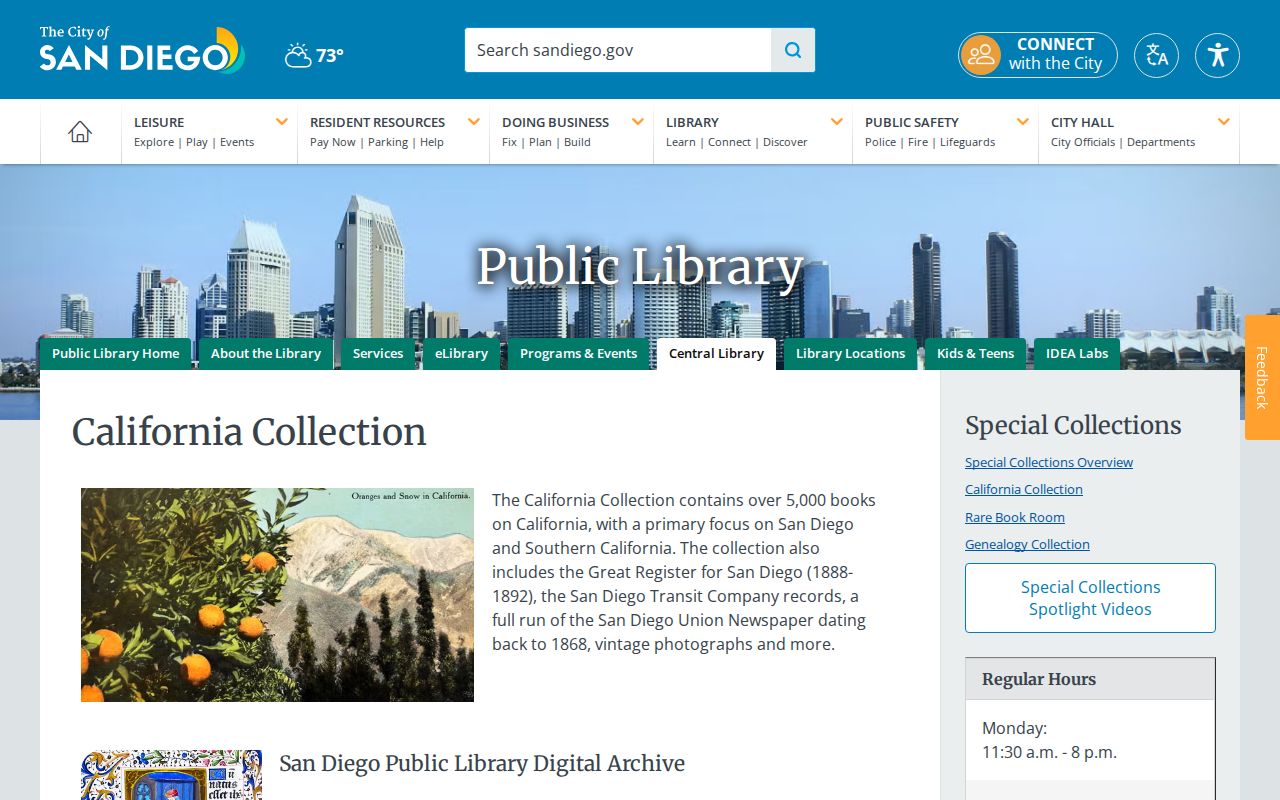
The San Diego Public Library California Collection holds more than 5,000 books and reports San Diego directory volumes from 1886 through 2021 onsite. Special Collections hours are Monday and Tuesday from 11:30 to 8, Wednesday through Saturday from 9:30 to 6, and Sunday closed. Its digitized “San Diego Yesterday” material covers 1887-1925, while digitized city archive PDFs cover 1925-1960. These are San Diego-centered collections, so confirm that a page actually names La Mesa or one of its older street forms.
The library collection page is the source for the San Diego directory view below.
The 1943 scan is explicitly a San Diego Directory Co. La Mesa volume. The 1958 R. L. Polk volume explains its alphabetical, street-order, and telephone sections. The La Mesa San Diego County Library branch at 8074 Allison Avenue, 619-469-2151, provides catalog help, local referrals, and card-based database access. Its posted hours are Monday 10-6, Tuesday and Wednesday 12-7, Thursday 10-6, and Friday through Sunday 10-5.
Read La Mesa’s 1943 City Directory Entry
The 1943 La Mesa directory scan shows how much meaning sits inside a short line. One entry reads Aaberg Julia Mrs clo prsr L K Emery r4668 Acacia av. Another reads Applegate Jas R (Oleida M) aircraftwkr CACorp h8169 Fairview av, followed by Janet L tel opr r8169. Spelling, initials, parentheses, and the small letters at the end all matter.
| Name | Surname followed by a given name or initials; “Mrs” can be part of the printed form. |
|---|---|
| Household clue | A spouse may appear in parentheses; “wid” identifies a widow notation in later entries. |
| Occupation line | Abbreviated work and employer wording, such as “aircraftwkr CACorp” or “clo prsr L K Emery.” |
| Address role | h marks a householder or home entry; r marks a person who resides there. |
| Street line | The house number and street name connect the alphabetical entry to a place. |
Repeated names at one address suggest household association, not legal kinship. An occupation line is historical context, not proof of a present affiliation. Directory publishers also warned that canvass data could be incomplete. Compare the line with a second edition, a census household, a newspaper notice, or a deed before drawing a firm conclusion.
- Criss-cross directory
- A reverse section that moves from street and number to a named householder, nearby addresses, phone details, and owner or resident marks.
- Householder index
- The address-order portion of a volume, often arranged by street so a researcher can move from a place to a name.
- Abbreviation key
- The volume’s legend for short forms such as
h,r, “wid,” and occupations. Find it before interpreting an entry.
Search La Mesa Directories by Street
R. L. Polk’s 1958 structure supports two directions of search. The alphabetical residents and businesses section starts with a surname or organization. The green-page Householders’ Directory and Street and Avenue Guide moves through street numbers in sequence, gives intersecting streets and phone details, and marks the listed owner or resident when the volume does so. A blue-page numerical telephone section adds a third route. Start with the known fact: surname to address, address to householder, or phone to name. Then compare the result with the other section and a nearby year.
The reverse method is especially helpful when a family name changed, a woman appears under a spouse’s name, or a house was renumbered. A street guide can reveal the next address to inspect even when the alphabetical page is hard to read. It can also show that a directory entry is a business or institution rather than a household. Polk described its data as coming from an actual canvass but disclaimed perfect completeness, so an absent name is not proof that a person was absent from La Mesa.
Note: A San Diego title can place La Mesa beside other towns, so confirm town, street, and year before linking entries.
Trace a La Mesa House Through Directories
The city landmark nomination for 4646 Nebo Drive is a ready-made La Mesa directory history. The property appears on the west side of Railroad Avenue in 1911-1923, then at 334 S Nebo in 1924-1926, 332 S Nebo in 1927-1930, and 4646 Nebo by 1931-1935. The structure did not move. The address language changed as the street system and numbering were revised.
The named households change too. Frederick Roehr appears early, followed by Andrew Lazarus, George and Johanna Moore, Johanna as a widow, Alvin and Grace Egrmayer, and Carl and Jessica Cooper. Later lines track Consolidated Aircraft, Consolidated Vultee, Convair, retirement, and Jessica’s widow notation through 1982, with later citations continuing to 2019. Those details show how a directory can preserve family and place history across decades without proving that every named person was a legal owner.
The larger La Mesa directory timeline helps place that house record in context.
| 1887 | History Center aggregate directory coverage begins; an uninterrupted annual run is not verified. |
|---|---|
| 1907 | La Mesa Scout begins, adding a local newspaper trail for later cross-checks. |
| 1912 | La Mesa incorporates, while older place names remain useful search variants. |
| 1931 | A San Diego Directory Co. title states regional coverage that includes La Mesa. |
| 1943 | The scanned La Mesa directory volume supplies the sample entry format. |
| 1958 | R. L. Polk describes alphabetical, street-order, and numerical telephone sections. |
| 1973 | History Center aggregate coverage ends; this is not a claim about the last printed volume. |
| 2021 | The San Diego Public Library reports its onsite city-directory run through this year. |
For the deed side of one address, the La Mesa past-residents records workflow follows the county chain separately. Pair both trails only after matching the legal description, parcel, street form, and year.
Use La Mesa Directories for Family History
A careful household search treats a directory as one layer in a source chain. It is useful for reconnecting with a classmate, understanding a family home, or placing a relative in the civic life of La Mesa. Use variants for initials, compound Spanish-language surnames, spouse-based entries, and older place names such as Allison Springs, La Mesa Springs, and La Mesa Colony.
- Choose the nearest known year and search the surname alphabetically. Record the full line, including spouse, occupation wording, address, and
horr. - Flip to the householder or street section. Compare the number, intersecting street, adjacent entries, and any owner or resident mark.
- Repeat in the next available edition. Note moves, widows, adult children, changed initials, and gaps instead of smoothing them into one identity.
- Pair directory years with the 1900-1950 federal census, La Mesa Scout notices, yearbooks, deeds, probate files, and obituaries. The 1950 census is the newest currently public under the 72-year release rule.
- Test why a name disappears. An obituary, cemetery record, probate case, estate deed, later address, or a missing volume may explain the break.
La Mesa History Center microfilm and vertical files are useful for local context. The San Diego County Archives provides historical maps, deeds, and vital collections, subject to certificate rules. Local funeral-home obituary archives are commemorative sources, not civil death indexes, so pair them with the county or court record that answers the event question.
La Mesa Directory Limits and Access
A La Mesa city directory can show that a name was printed beside a place in a particular year. It cannot by itself prove present occupancy, legal ownership, kinship, or a complete household. Directories may omit children, use a mailing address, lag behind a move, or include a wider San Diego postal area. Older La Mesa street names and changing numbers create another trap. Compare the entry with the parcel, deed, court, vital, or archival record that actually answers the question.
When the shelf has a gap, use the record custodian rather than asking a library or clerk to create a new roster. The La Mesa City Clerk publishes agendas, minutes, and other records through the city’s Document Center. A focused CPRA request can name an existing address file and date range. The city’s Laserfiche work plan targets 10-15% digitization in fiscal year 2024-25, 40% in 2025-26, 70% in 2026-27, and 100% in 2027-28, so access may be uneven during the transition. California’s Safe at Home program also explains why some current addresses will not appear in open records.