
La Mesa Resident Lookup Coverage
A La Mesa resident lookup separates property role from household fact. San Diego County’s assessment roll turns an address into an APN, but owner names stay off the public Internet roll. The Recorder index supplies grantor and grantee roles. Court results show case association; vital records establish events.
| Record | What It Confirms | Where | Access |
|---|---|---|---|
| Secured assessment roll | APN, assessed values, tax status, and property characteristics | San Diego assessment search | Free web roll; owner name suppressed online |
| Recorded documents | Grantor or grantee role, recording date, document type, and legal description | ARCC Official Records Index | 1970-present index; images by kiosk or copy order |
| Superior Court index | Case number, court location, party association, and case category | San Diego Court Index | Public index with case-type and confidentiality limits |
| Vital records | Birth, death, marriage, or divorce event details and possible relationships | County ARCC or CDPH | Authorized and informational copy rules differ |
| Business and license filings | Public role, entity address, license status, or trade-name connection | California SOS, DCA, and county FBN files | Public affiliation evidence, not residence proof |
Match the row to the starting fact. No single La Mesa record proves occupancy.
Choose a La Mesa Lookup Record
Start with the strongest fact. For a known La Mesa address, run the secured roll by address and preserve the APN. The form accepts Parcel Number, Address, or Street Name. Enter number and street name without direction, type, or city. A parcel query uses at least eight digits, such as 123-456-78-90. The result provides property context, not an online owner name.
For recorded ownership, search the ARCC index as both grantor and grantee. It covers real-property documents from 1970 to the present, and new instruments may take 24 to 48 hours to appear. The web result is an index only. An image can add vesting, a return-mail block, legal description, and notary facts, but a return address is not occupancy proof.
La Mesa Court Lookup Results
The San Diego Superior Court is the trial court for La Mesa matters. Its public index has Party Name, Case Number, and District Attorney number paths for Civil, Criminal, Family, Mental Health, and Probate. Start with the San Diego Court Index; its access instructions explain file requests.
| Party Name Search | Enter the party name in the court index; dynamic subfields and wildcard behavior require the live form. |
|---|---|
| Case Number Search | Use a known case number to narrow the result to a specific court record. |
| DA Number Search | Use a District Attorney number for criminal indexing when that number is known. |
| Basic result | Case number, court location, indexed party association, and case category. |
The index is not a criminal-history report. It does not show charges or disposition, and dismissed matters can remain indexed. Juvenile, traffic, adoption, sealed, confidential, and many pre-1974 records are outside the basic result. A same-name hit needs middle initials, dates, connected parties, and file support.
To inspect a file, contact the business office named by the index. Picture ID is required; clerk pulls are limited to 10 cases, and a nonparty search over 10 minutes can incur the Government Code section 70627(c) fee. Copies cost $0.50 per page; some files need retrieval time.
Verify a La Mesa Resident Lookup
A resident lookup checks one person across independent records. Keep the full name, middle initial, former or married name, suffix, approximate age, and one known address. Recorder entries preserve instrument spelling. Before January 1, 2012, common words could be abbreviated; newer indexing leaves words as written. Try spacing, hyphenation, initials, and name order when a result is thin.
- Resolve the known address to an APN through the assessor or GIS route. Keep situs, mailing address, and legal description separate.
- Search the Recorder as grantor and grantee. Save the document number, date, and type before ordering or viewing it.
- Run the court party search and compare middle name, dates, public address, counsel, and connected parties. Do not merge namesakes from a name alone.
- Use a vital, probate, license, business, or obituary record to test the relationship or event.
- Record contradictions. A remote mailing address, former name, directory lag, or entity-owned parcel can explain a mismatch.
- Docket
- The court’s running record of a case, including filings, events, hearings, and sometimes disposition entries.
- Index versus image
- An index is the searchable summary. An image is the underlying instrument or filing, often available only at a kiosk or through a copy request.
- Certified copy
- A custodian-certified reproduction whose seal or certification states that it matches the record held by that office.
La Mesa Vital Records Lookup
Vital records answer event questions, not address questions. San Diego County ARCC issues copies for county births, deaths, and county-licensed marriages. CDPH maintains statewide records. A divorce decree is a Superior Court record; a state divorce certificate is statistical, not the judgment.
| Record | Copy distinction | 2026 fee |
|---|---|---|
| Birth | Authorized classes may receive an authorized copy; others may request a certified informational copy. | County $34; state VS 111 $31 |
| Death | Statutory relatives and representatives may qualify for an authorized copy; other applicants receive informational copies. | $26 county or state |
| Public marriage | Broader access than a confidential marriage; copy type and relationship still control. | $19 county or state |
| Confidential marriage | Available to a party to the marriage or by court order; an existence letter may be offered where allowed. | $19 county certificate |
| Divorce record | Superior Court holds the decree; CDPH form VS 113B requests the available state record. | $18 state record |
The county accepts in-person, online vendor, and mail requests. In person needs photo ID. Online ordering adds $12.95 handling and optional $19 expedited delivery. Mail authorized copies need a sworn statement and notarized acknowledgment; informational copies do not. Fees are nonrefundable, so no record generally produces a Letter of No Record.
Use the current San Diego County vital-records page for eligibility and the California vital-records hub for statewide applications. Birth and death requests should wait three weeks; marriage copies take about 10 business days. Use current 2026 fees.
La Mesa Resident Searches for Heirs
Some searches begin with a relationship rather than an address. An heir or estate contact belongs in the probate index and file, followed by permitted petitions or orders. Affidavits of death and estate deeds can connect an estate to a parcel. An obituary may add a clue, but living-person contact details need confirmation.
For a former classmate, the La Mesa History Center is a strong bridge. Its research room holds directories stated as 1887-1973, Grossmont and Helix yearbooks, La Mesa Scout microfilm, photos, oral histories, and address files. It is normally open Saturdays from 1 to 4 except holidays for on-site research. The History Center archives can connect a school name to a later notice or address history. Historical volumes are gathered on the La Mesa city directories page.
Birth-family research has a firm boundary. California adoption records are confidential. Use CDSS adoption services, court process, mutual-consent mechanisms, or an authorized intermediary. Do not reconstruct a protected identity from unrelated hints. For a deceased person, pair a death index with probate, cemetery material, or an estate deed.
La Mesa Resident Record Clues
A business record can confirm a public role without turning a business address into a home address. SOS bizfile searches by entity name or file number and returns entity type, status, dates, addresses, agent, filed managers or officers, and filing history. Basic results cap at 500 matches; advanced filters narrow type, status, disclosure, and filing date.
The SOS search matches a trade name to an entity. County fictitious-business-name filings bridge storefront name to registrant. La Mesa’s business-license list can be requested under CPRA at $0.50 per listing, capped at $100 for 200 or more. Label an agent, shop, or mailing address accurately.
The California Department of Consumer Affairs license search can add license type, number, status, dates, location, and discipline, depending on the board. A State Controller unclaimed-property result can show a reported name, city, reporting business, and clue. Search is free, but a claim needs proof. Neither proves residence.
The California business search shows the public entity route used for this check.
The search screen is a starting index. Confirm the filing role, dates, and address type before linking a business record to a person.
The California unclaimed-property search provides the matching state channel for a name and city clue.
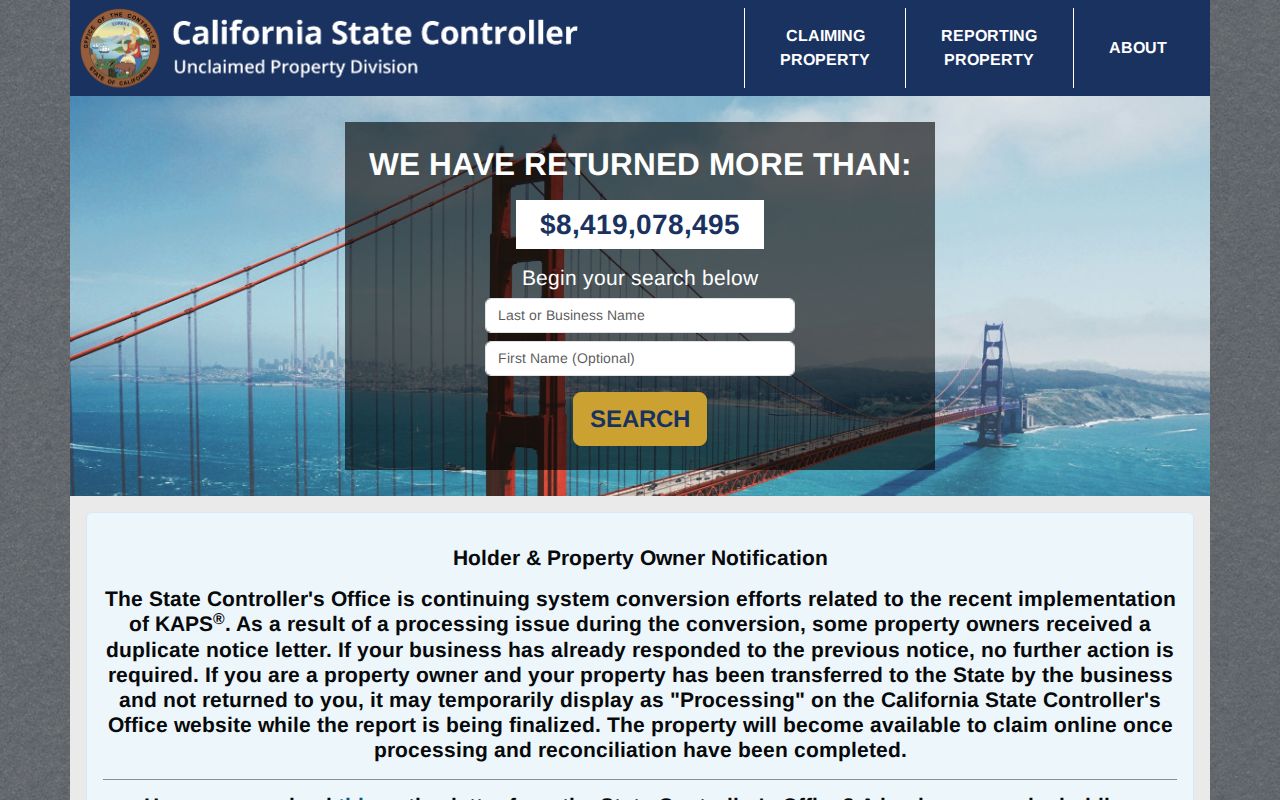
An unclaimed-property result can point toward an older relationship, but only the claimant or heir can finish the process with supporting proof.
La Mesa Resident Records by Request
When an index does not expose a record, use the custodian’s request channel instead of asking a clerk to build a person list. The California Public Records Act, Government Code sections 7920.000-7931.000, reaches existing agency records. Name the La Mesa department, record type, address or case number, and date range. Ask for records, not an answer.
La Mesa’s CPRA portal searches prior releases and files new requests. The City Clerk holds many legislative and administrative records; permits and code files may require the Building counter or MaintStar. The city need not create a roster. Ask for a specified permit, code case, council application, or police-record category, subject to redaction.
County fallbacks are specific: use an ARCC kiosk or copy order for deeds and older APN routes, the Superior Court business office for a file, and the Registrar of Voters only for an approved election-data purpose. CPRA normally brings a determination within 10 calendar days, with a possible 14-day extension. It is not a copy-delivery deadline.
La Mesa Resident Lookup Privacy
California voter data is not an unrestricted street directory. My Voter Status is an identity-gated self-lookup for the user’s registration and election information, not another person’s name. A county voter-file request requires an approved electoral, scholarly, journalistic, political, governmental, or audit purpose under Elections Code sections 2188 and 2194.
Approved fields can include name, registration date, residence or mailing address, precinct, party preference, status, and participation history. History shows an election, date, and method, never ballot choices. Driver-license or California ID numbers, Social Security data, unique federal identifiers, and signatures are excluded. A personal street directory is not a permitted use.
Protected residents may use California’s Safe at Home program for a substitute mailing address and confidential voter registration. It protects qualifying people prospectively, not earlier public records. A missing match can reflect privacy protection, a recent registration, or an address, birth-date, or ZIP mismatch.
La Mesa Resident Lookup Limits
Records answer narrow questions. A deed confirms a recorded role; an assessor result identifies a parcel; a court index confirms a case association, not a charge or outcome. A license, entity filing, or vital copy has its own scope. None alone proves occupancy or permission to contact someone.
California privacy law distinguishes public records from private data. Consumer rights can address private businesses, including deletion or opt-out requests, but do not erase lawful government records. DROP began one-request data-broker deletion in 2026; recurring processing begins August 1, 2026. A private opt-out is not expungement.
Lawful personal use. A La Mesa resident lookup is for family history, reconnecting, estate work, or a public affiliation. Do not use records to stalk, harass, intimidate, or cause unwanted contact. California Penal Code sections 646.9 and 653.2 address stalking and harmful publication.
When a result looks wrong, preserve the record number, ask the custodian about correction or access, and keep a source note. That habit makes a resident lookup more accurate.