
La Mesa Resident Search Starts Here
A useful La Mesa residents directory search begins with the fact already in hand. A known street points toward the secured assessment roll and parcel map. A full name fits the Recorder’s grantor and grantee index, a court party search, or a business and license record. A family question may belong in a directory, obituary, probate file, or yearbook instead. Names should be kept with middle initials, suffixes, former surnames, and spelling variants because each source preserves a different form.
The trail is strongest when each record answers one narrow question. A parcel can identify an APN and assessed value, but the owner name is suppressed on the public Internet. A deed can show a recorded party and a legal description, but it cannot prove who slept at the address. A court index can show a case association, but a dismissed entry can remain indexed. A directory entry can name a householder, but it may lag a move or omit a household member.
- Normalize the name or address, including old spellings and former street names.
- Resolve an address to an APN, or choose the record family that fits the name question.
- Read the first result as a lead, then compare dates, roles, and place across another custodian.
- Order an image, visit a kiosk, use a library collection, or file a focused request when an index stops.
- Write down what the record proves and what remains an inference about residence.
Offices Behind the La Mesa Residents Directory
La Mesa is an incorporated city in San Diego County, not a separate records county. City Hall keeps municipal material such as agendas, permits, licenses, code files, and police records. The consolidated San Diego County Assessor/Recorder/County Clerk holds the durable property, deed, fictitious-business-name, and certificate trail. San Diego Superior Court holds probate and case records, while state agencies control voter status, statewide vital guidance, licenses, and confidentiality programs.
San Diego County ARCC
Assessor / Recorder / County Clerk
San Diego County
619-236-3771 assessor
619-237-0502 recorder
San Diego Superior Court
Case indexes, registers, probate, and files
Countywide trial-court records
Use the case business office
La Mesa City Clerk
Agendas, minutes, ordinances, requests
8130 Allison Avenue, La Mesa
619-667-1133
California Elections
Authenticated voter-status lookup
State service for San Diego voters
County: 858-565-5800
These desks do different work. The County Recorder does not hold probate files, the City Clerk does not hold deeds, and the voter tool is not a public name directory. The right custodian is part of the answer.
Build the La Mesa Property Record
The San Diego County Secured Assessment Roll Search turns an address into the parcel number that joins several record systems. Its verified search modes are Parcel Number, Address, and Street Name. An address query takes the number and street name, while the instructions say to omit direction, street type, and city. A parcel query accepts a full APN such as 123-456-78-90, with a shorter minimum format also accepted. The result supplies assessed land and improvement values, base-year context, and property characteristics.
The public roll does not display the assessee or owner name online because California Government Code § 7928.205 restricts that posting. The assessor’s Public Information channel and free ARCC kiosks can provide ownership, mailing versus situs information, sales, maps, and characteristics through lawful access. Neither a mailing address nor a homeowners’ exemption is a household roster. The APN is a join key, not proof of occupancy.
The Secured Assessment Roll Search shows the address and APN search screen. The image makes the online-versus-counter boundary clear: a value result is available on the web, while owner detail requires the assessor channel.
Use the APN when moving from the roll to parcel maps or an in-person deed search. It keeps a street name change from breaking the record trail.
- Parcel
- A county assessment unit identified by an APN, with mapped boundaries and recorded-map references.
- Situs address
- The physical location of a parcel, which may differ from its mailing destination.
- Index
- A finding aid that lists key facts but may not contain the underlying record image.
- Criss-cross directory
- A reverse directory arranged by street or address rather than only by surname.
La Mesa Deed Records Since 1970
The ARCC Official Records Index is the strongest online name trail for recorded real-property instruments from 1970 to the present. Search by Grantor or Grantee. Results identify the indexed party and role, recording date, document type, and document number. Newly recorded instruments may take about 24 to 48 hours to appear. The web result is an index only. It does not display the document image.
When the index points to the right instrument, an account holder can order a paper copy. The county prints online orders the next business day and advises allowing three to five business days for delivery. Images are not emailed or faxed. A mail request needs the document number, recording year, at least one party name, and document type. Public kiosks provide image access and older records, with APN searching still available at five ARCC kiosks after December 9, 2024.
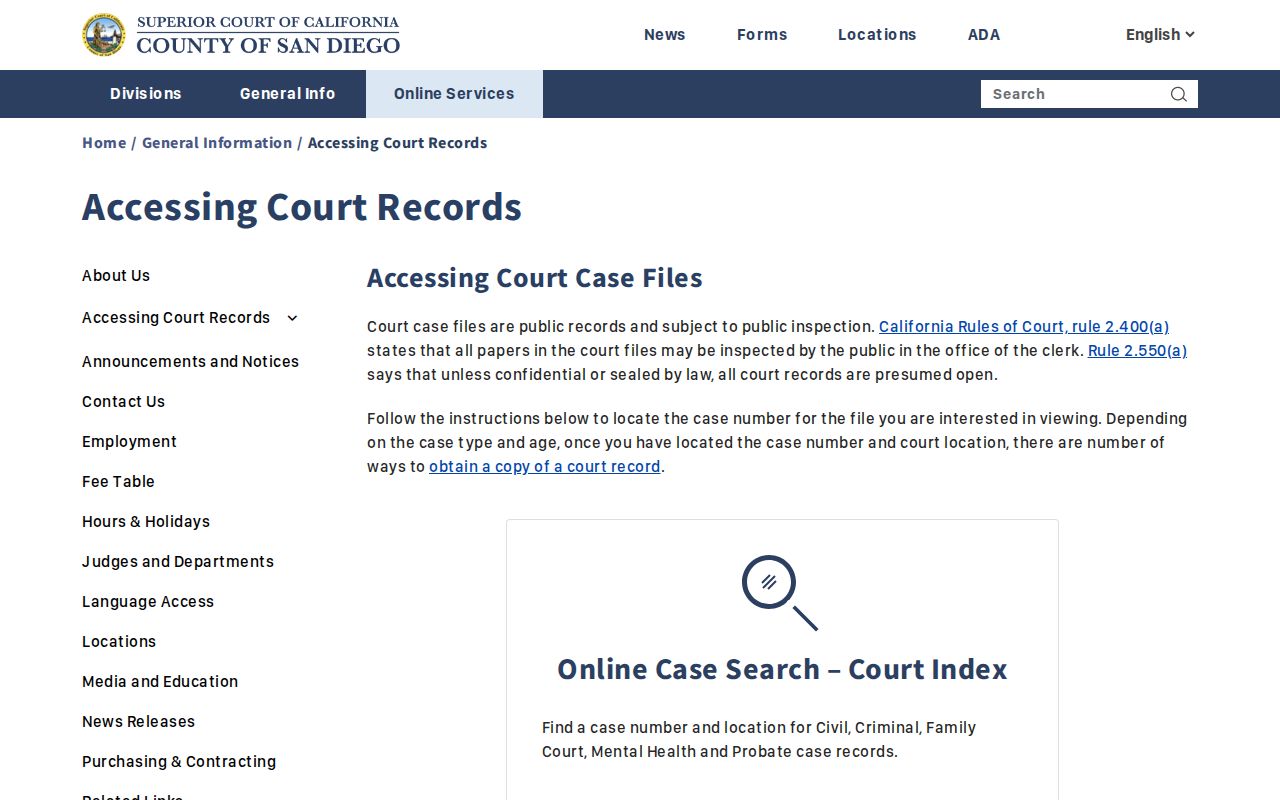
The San Diego Official Records Index is the source for the name search. An index hit shows a recorded role, not a present resident. The image can add vesting, the return-mail block, legal description, signatures, and notary facts. Treat a return address as a contact clue only.
Military discharge material is not publicly displayed under Government Code § 6107. That exception is one reason a complete-looking deed trail can still have a protected gap.
La Mesa Voter Status, Not a Directory
My Voter Status is designed for a person to confirm their own registration after entering identity fields. It can return the authenticated user’s registration and election information, but it cannot browse another person by name, street, or ZIP. California Elections Code § 2194 makes registration information confidential in general and allows specified governmental, electoral, scholarly, journalistic, and political uses. Driver-license numbers, Social Security numbers, and signatures are not released.
A voter-file request is a separate process. The San Diego Registrar of Voters requires a written application and a qualifying purpose. The county lists a $75 one-time voter file, a $285 current-election vote-by-mail FTP subscription, a $216 specialized report, and specific-voter research at $98 per hour after an estimate. A street-wide personal directory is not a specific-voter record. Participation history shows whether and how a person participated, never how they voted.
The California My Voter Status form illustrates the self-check boundary. County guidance says an address, birth date, or ZIP mismatch can cause a no-match, and a recent registration may not yet be complete.
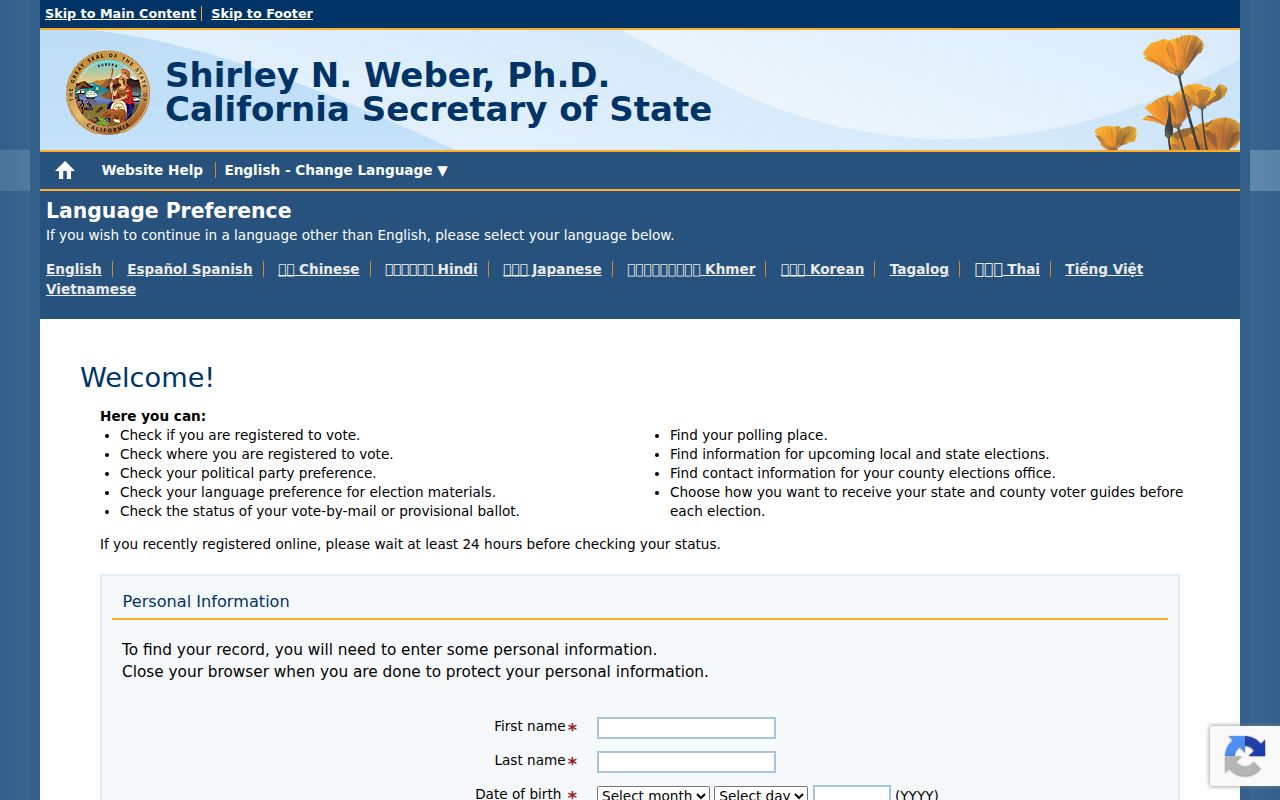
| Field or mode | Type | What it means |
|---|---|---|
| Personal identity fields | Text or date | Address, birth date, and ZIP are matching elements in county guidance. |
| County context | Selection or service route | California service routes the authenticated voter to the county system. |
| Lookup / submit | Button | Self-verification, not public browsing. |
Safe at Home participants can use confidential voter registration. A failed public search may reflect a legal protection, not a missing person.
Current La Mesa Resident Directory Sources
Current entries are spread across records made for different purposes. The most useful source depends on whether the goal is a parcel, a recorded transfer, a public role, a court association, or a self-check. No single row below establishes the full set of people at an address.
| Source | What it can show | Keeper | Access boundary |
|---|---|---|---|
| Secured assessment roll | APN, values, characteristics | San Diego County Assessor | Owner name suppressed online; phone or kiosk route |
| Recorded documents | Grantor, grantee, deed role, dates | ARCC Recorder | 1970-present web index; image ordered or viewed |
| City staff directory | Public name, title, email, phone | La Mesa | City role, not private residence |
| Business and license filings | Entity, agent, license status | California and county offices | Public-facing affiliation, not home proof |
| Historical directories | Past householders and addresses | Libraries and La Mesa History Center | Onsite, digitized, or microfilm by collection |
The city’s online staff directory searches by category, first name, and last name, returning public staff names, titles, emails, and telephone numbers. It helps identify a department contact, not a private resident. Property-tax status can confirm a bill year and APN, but the person who pays a bill is not necessarily every person who lives at the situs.
La Mesa Court Records Need Context
The San Diego Superior Court Court Index covers indexed Civil, Criminal, Family, Mental Health, and Probate cases. Its visible search modes are Party Name Search, Case Number Search, and DA Number Search. The basic index can return a case number, court location, indexed party association, and case category. It does not supply criminal charges or disposition. Dismissed matters can remain indexed, so a name hit is not identity proof or a history report.
Richer registers of actions and actual files follow a separate access path. A visitor may need the courthouse that holds the file and picture ID to view it. Clerk pulls are limited to 10 cases per transaction. Paper, microfilm, or microfiche copies cost $0.50 per page, and a nonparty search over 10 minutes can incur the Government Code § 70627(c) search fee. Mail requests need the case number, party names, exact document names, contact details, payment, and postage.
Juvenile, adoption, sealed, confidential, Traffic/Minor Offense, and pre-1974 matters do not fit the basic public index. Federal cases for the Southern District of California use PACER, which requires an account and charges under the current federal schedule.
- Case number and court location identify the file path.
- Party association shows how the name appears in the index.
- Case category narrows the right register of actions.
- File review supplies context that the index omits.
La Mesa Probate Records for Heirs
Probate is a documentary route for an estate question, not a shortcut to a current household list. Search the Superior Court probate index by decedent name, record the case number and petitioner or counsel, then ask the court about allowed petitions, notices, or orders. A recorded affidavit of death, trustee deed, or personal-representative deed can connect the estate to a parcel. An obituary may add a relationship clue, but living-person contact still needs a separate, lawful confirmation.
Vital certificates have their own rules. ARCC issues San Diego County birth, death, and marriage certificates, while the California Department of Public Health provides statewide forms and guidance. Authorized copies require a qualifying relationship and sworn statement. Informational copies are marked as not valid to establish identity. Confidential marriage certificates are limited to a party or court-order party. These limits matter when a family search reaches a sensitive event.
For a birth-family connection, California adoption records remain confidential. CDSS adoption-services channels, court procedures, mutual-consent mechanisms, or an authorized intermediary are the proper route. For a former classmate, La Mesa-area yearbooks, the *La Mesa Scout*, local newspapers, and alumni groups can supply a safer historical lead than a guessed current address.
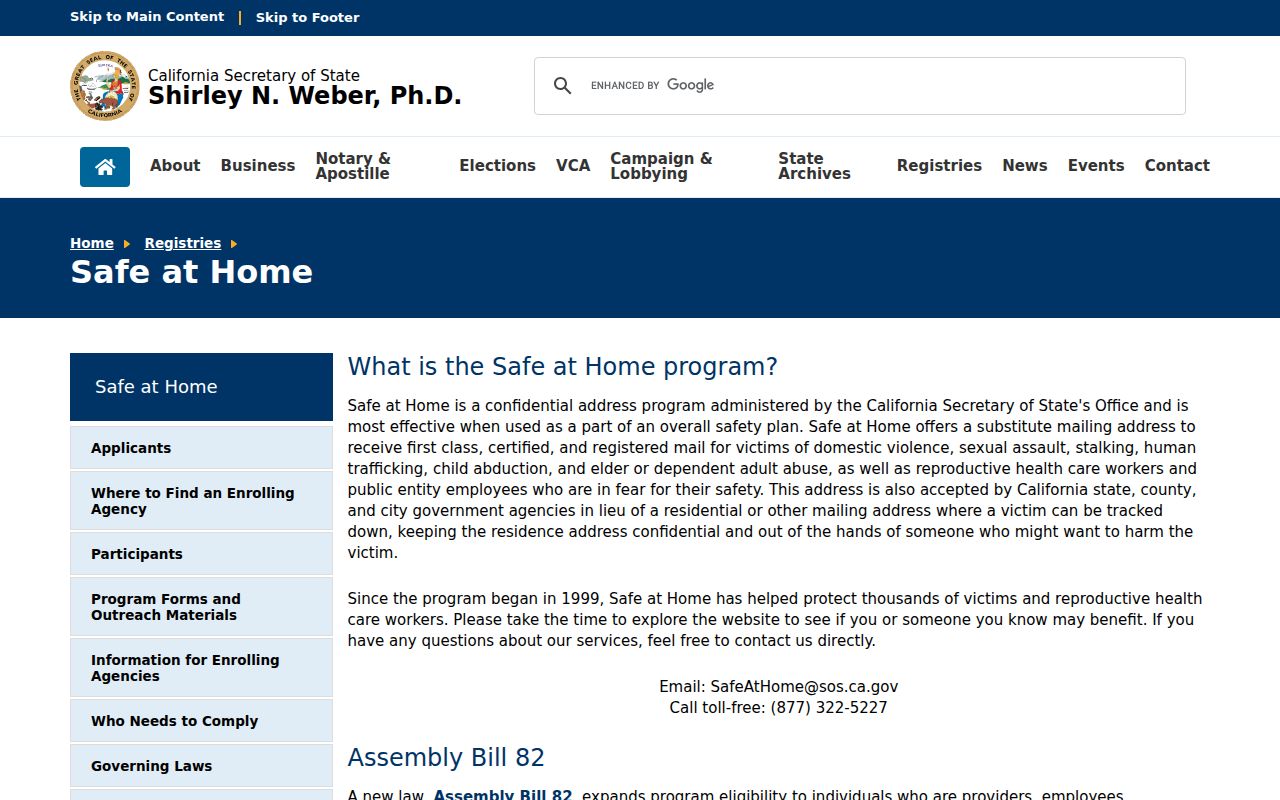
The Safe at Home program explains why some current addresses are replaced by a confidential mailing address. A protected record should stay protected.
Probate, deeds, obituaries, and directories work best as a chain of dated clues. They do not turn private contact details into public directory content.
La Mesa Directory History Stack
The La Mesa History Center’s research room brings together several kinds of evidence that are hard to join online. Its holdings include La Mesa city directories stated as 1887-1973, *La Mesa Scout* microfilm, Grossmont and Helix High School yearbooks, photographs from the late 1800s forward, address and subject vertical files, landmark nominations, oral histories, Woman’s Club records, Community Welfare Association ledgers, and family collections. The room is normally open Saturdays from 1 to 4, except holidays, and materials are non-lending.
That mix supports a real La Mesa residents directory question. A directory can place a name at a street address, a Scout notice can date an event, a yearbook can connect a school activity, and a landmark packet can reconcile a changed street number. The collection range is aggregate, not a promise of an unbroken annual run. Ask staff about missing years, copy fees, and the best shelf for the address or family.
The La Mesa History Center archives are the local starting point for that research stack.
For broader San Diego material, the San Diego Public Library California Collection holds city directories from 1886-2021 onsite, digitized directories from 1887-1960 in two named collections, San Diego Union coverage beginning in 1868, and more than 800 maps. A “San Diego” volume can include suburban towns, so each edition needs a La Mesa check.
Request La Mesa Records Offline
The California Public Records Act, now Government Code §§ 7920.000-7931.000, gives any person a right to request many existing state and local records, subject to exemptions. An agency ordinarily decides within 10 calendar days whether it has disclosable responsive records. Unusual circumstances can add 14 days. That is a determination deadline, not a promise that copies arrive in 10 days. Inspection is free; copy charges are generally limited to direct duplication cost or a statutory fee.
A focused La Mesa request names the department, record type, address or permit number, and date range. The City Clerk’s CPRA portal can search released records and file a request for an existing record under the city’s retention schedule. The Document Center and Agenda Center are first-line sources for minutes, packets, forms, and published records. Building history may route through MaintStar, the counter, or a request when the public portal lacks a crawlable historical search.
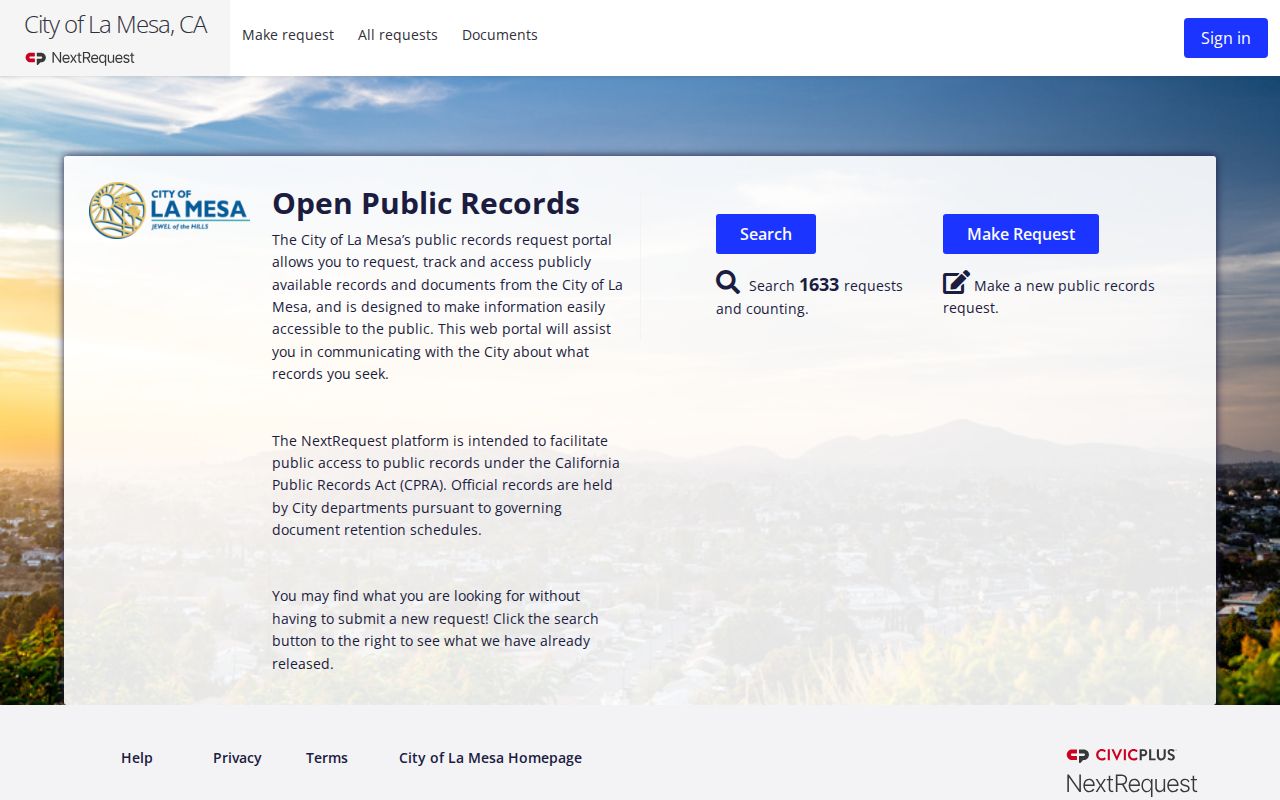
The La Mesa public-records request portal shows the city’s search and request entry points.
For county deeds, use an ARCC kiosk or copy order. For court files, contact the business office that holds the case. For certificates, use the county or CDPH application that matches the event and eligibility.
La Mesa Resident Records and Privacy
Public access is not the same as unlimited use. California’s voter-file rules restrict purpose and dissemination. The Driver’s Privacy Protection Act closes motor-vehicle personal data except for listed permissible uses. Safe at Home protects a substitute address for eligible participants, and private groups, utilities, delivery records, and household-member details are not public resident rolls.
Personal and lawful use. Use La Mesa records for family history, civic research, reconnecting, property curiosity, or personal safety awareness. Do not use an address or name trail to stalk, harass, intimidate, or cause unwanted contact. Verify with the custodian before acting on a record.
Compiled search tools can merge property, phone, court, marketing, and change-of-address clues. They may be stale or join two namesakes. A commercial result is only an unverified lead; return to the original ARCC, court, city, library, or state record for the source chain.
When a person is protected, a search gap is a boundary to respect. It is not an invitation to infer a hidden address from relatives, neighbors, or public photos.
Changes to La Mesa Record Access
La Mesa’s records landscape is in motion. The city’s Laserfiche work plan targets assessment and digitization of 10-15% of records in FY 2024/25, 40% in FY 2025/26, 70% in FY 2026/27, and 100% in FY 2027/28, followed by maintenance. During migration, a failed portal search may reflect uneven scanning or retention work rather than proof that a record never existed.
The county’s APN search shift is more concrete. AB 1785 removed APN searching from official-record web indexes on December 9, 2024. Grantor and grantee searching remains online, while APN queries remain available at ARCC public kiosks. A parcel-to-deed search now often has a counter step.
California’s DROP service began one-request data-broker deletion in 2026. Beginning August 1, 2026, registered brokers process requests at least every 45 days, delete matched nonexempt data within 45 days, and report status through the service. That private-data process does not erase a county deed, court index, or lawful government record.
La Mesa’s official city gateway remains the best check for department links, forms, and new records notices.
Current fee notices also matter. AB 64 raised key vital-record fees by $2 on January 1, 2026. Older downloadable forms can show stale amounts, so confirm the live county or state fee page before mailing payment.
Historical La Mesa Resident Directories
The historical La Mesa residents directory is a shelf, not a single database. The History Center’s stated 1887-1973 aggregate run sits beside San Diego Public Library’s 1886-2021 city-directory holdings and digitized segments from 1887-1925 and 1925-1960. The 1943 La Mesa volume was published by San Diego Directory Co. A 1958 R. L. Polk volume explains the alphabetical resident pages, green Householders’ Directory and Street and Avenue Guide, and blue numerical telephone section.
Directory entries can show a name, spouse in parentheses, an abbreviated occupation or employer, house number, street, and `h` or `r` marks. They can place a person in a household without proving legal kinship or title. The full collections, entry anatomy, and year-by-year tracing method are developed on the La Mesa city directory collections page. Modern address-keyed work belongs on the By Street page.
One La Mesa house shows why the old shelf deserves care. A property later known as 4646 Nebo appeared as Railroad Avenue, 334 S Nebo, and 332 S Nebo before the later number settled. Address text changed while the house remained. Search the street variant, parcel, and directory year together.